Every "bundle checker" you're already using is lying to you. The tools you trust are built to hide bundles, not find them. Insert @AxiomExchange, @gmgnai, @tradewithPhoton, or @TradingTerminal, and their in-app "bundle detector" that you turn to for safety.
Every one of them has a little badge, a bundle percentage, a holder breakdown, a green checkmark that tells you "looks clean."
We consider the current tools used on these terminals mere theater.
The current checks are shallow. They glance at the first few blocks after launch, count wallets that did basic bundle buys or sent funds from one to another, slap a number on it, and call it a day.
They catch the laziest, most obvious snipers, the ones who weren't really trying to hide. The moment a team staggers their buys across a few blocks, routes through different frontends, or funds wallets through a couple of hops, the badge goes green and you ape into a farm.
Now look at what our industry-leading trading terminals and platforms ship constantly:
- One-click multi-wallet buying: fund and fire 20 wallets at once.
- Built-in bundling so your buys land in the same block and your chart looks organic.
- Privacy and obfuscation features: fresh-wallet generation, funding routers, @vanishTrade, anything to make a coordinated entry look like 20 strangers showing up at once.
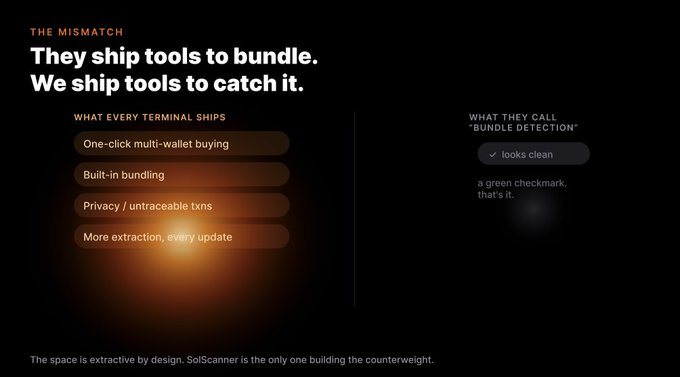
Sit with that mismatch. The detection is a toy. The developers behind your day-to-day detection tools aren't innovating.
Meanwhile, the evasion is a polished, well-funded, constantly-shipping product. These platforms are selling the rope to both sides, they sell you the bundling kit, then sell the next guy a "bundle checker" too weak to catch the kit they just sold.
Both sides pay. The house always wins. This has to change.
User profitability and user safety are supposed to balance. Right now the scale is bolted to the floor on the wrong side.
SolScanner is the only one building the other half. While everyone else races to make coordination easier and traceability harder, we're innovating on the detection side, making coordinated wallets visible, no matter how they try to stagger, route, or launder their way past the green checkmark.
What a real bundle looks like under the hood
A "bundle" isn't one thing. The lazy version is 20 wallets buying in the same block. The sophisticated version is 20 wallets that look completely independent, different blocks, different timing, different amounts, but share infrastructure fingerprints they can't scrub.
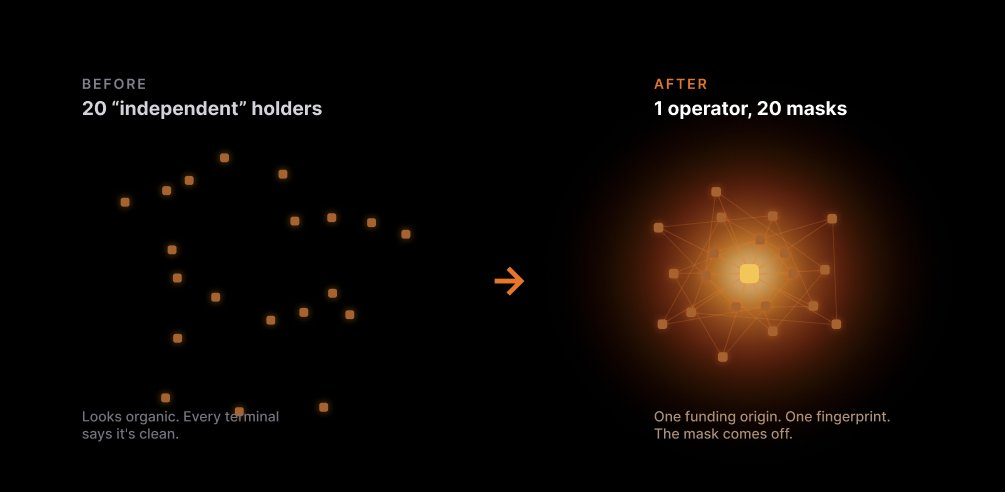
SolScanner doesn't check one signal. It runs a stack of them. A single match might be coincidence. Five matches across five independent dimensions is a wallet farm with a paint job.
But coordination leaves residue. When one operator fires twenty wallets, those wallets share things their owner never thinks about and can't easily scrub, quiet, structural similarities baked into how the buys were executed, not just when. Any one of those similarities could be coincidence.
SolScanner's edge is that it doesn't rely on any one of them.
We don't run a single check and print a badge. We correlate a range of independent behavioral and infrastructure signals at once, then ask a harder question than "did these land in the same block?"
We ask: across everything we can observe about how these wallets entered, how many of them line up in ways that random, unrelated traders never would?
One match is noise. A stack of independent matches, pointing at the same cluster of wallets, is one operator wearing twenty masks. The detector is built specifically to survive the tricks designed to beat the shallow tools, the staggering, the routing, the timing games.
The exact signal mix and weighting is ours, and it's the part we don't publish, because the whole point is that bundlers can't tune against what they can't see.
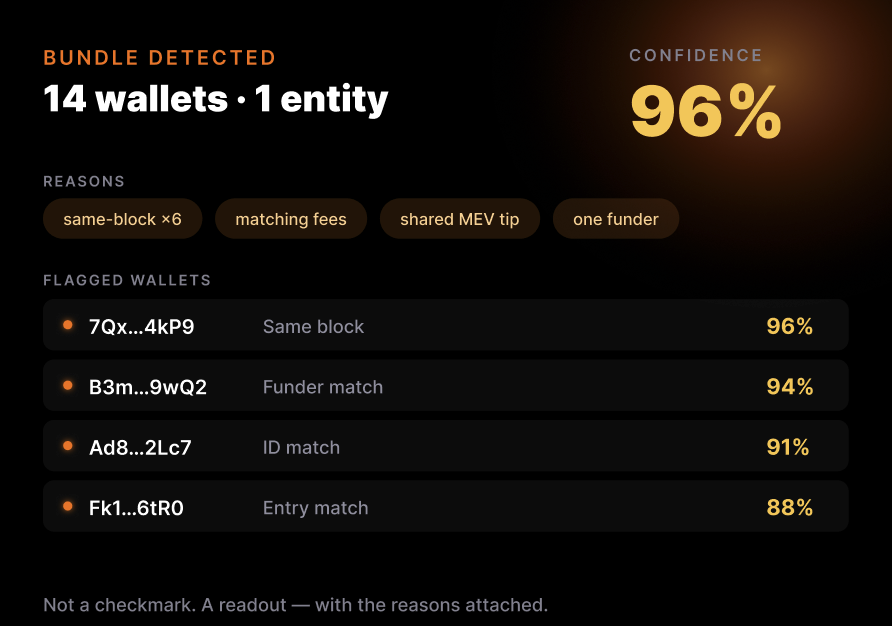
The result: a confidence score with the reasons attached, not a single green light, but a readout of why these wallets are one entity, and how sure we are.
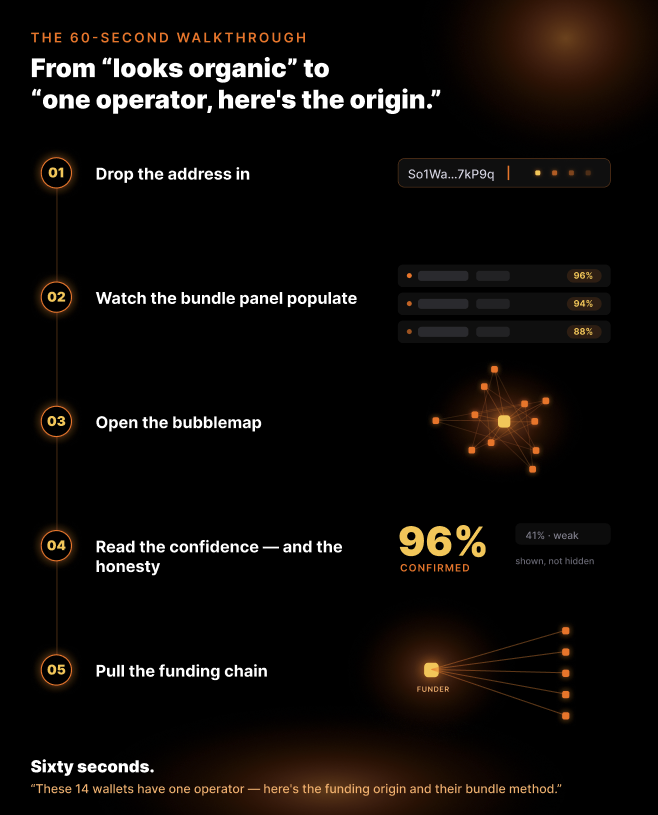
The 60-second walkthrough
Here's the actual flow. Pick a token that just ran, or a wallet you're suspicious of.
1. Drop the address in. Paste the wallet (or the contract, for a token-wide scan) into the SolScanner.app web app. Results start streaming immediately; you don't wait for the full history before signals appear.
2. Watch the bundle panel populate. As the scan runs, the detector correlates its signals in the background. Within seconds you get a list of flagged wallets, each with a confidence score and a plain-language reason it was flagged. You're not staring at a single badge, with us, you're reading why each wallet got pulled into the cluster.
3. Open the bubblemap. This is the moment it clicks. The force-directed graph renders the target and every flagged wallet as a network, and twenty "independent" buyers collapse into one tight, obviously-coordinated cluster on screen.
4. Read the confidence, and the honesty. High confidence with multiple independent reasons firing = this is one entity, full stop. A single weak signal? SolScanner tells you that too, instead of pretending. Honest detection means honest uncertainty, the exact opposite of a checkmark that's always green.
5. Pull the funding chain (the kill shot). For each flagged wallet, trace who funded it. Bundles built from wallets that share a funding origin, or that chain back through one source, are the cleanest confirmation there is. The mask doesn't just slip; it comes off every single on-chain extractor.
Sixty seconds. From "20 holders, looks organic" to "these 14 wallets have one operator, here's the funding origin and their bundle method."
Why this matters
Every other platform is optimizing the extraction. Easier bundling, easier multi-walleting, more privacy for the people coordinating against you, and a detection badge weak enough to keep you comfortable while you walk in.
SolScanner is building the counterweight. Not a checkmark. A scanner that assumes the bundler is trying to hide, correlates signals they can't all scrub at once, and shows you the picture, so the asymmetry finally tilts back toward the person actually putting money on the line.
The bundle was always there. We just let you see it in a few clicks.
Start scanning on SolScanner.app